| Year | |
| Event | Somali protests and civil war |
| Impact | Reshaped Somalia's political and economic trajectory for decades |
| Outcome | Larger popular uprising against monarchy • Protracted civil war • Collapse of Somali kingdom • Establishment of socialist republic aligned with Soviet Union |
| Trigger | Rising food prices • Economic hardship |
| Initial protests | In Mogadishu, capital of Somalia |
| Government response | Brutal crackdown on protesters |
The 1975 Somali Protests were a series of widespread demonstrations and civil unrest that occurred in the Kingdom of Somalia during the mid-1970s. Unlike the military coup that toppled the monarchy in our timeline, these protests were primarily driven by economic factors rather than political repression.
In the 1970s, Somalia was a constitutional monarchy ruled by King Mudaffar Gobrono. The country had experienced a period of relative stability and economic growth in the decades following independence from British Somaliland and Italian Somaliland in the 1960s.
However, by the mid-1970s, Somalia was facing significant economic challenges. The global oil crisis had driven up the costs of fuel and food imports, leading to high inflation and shortages of essential goods. At the same time, a severe drought had devastated the country's agricultural sector, further straining the food supply.
The Somali government's efforts to control prices and ration food were seen as ineffective and heavy-handed by the population. Discontent began to grow, especially in the capital city of Mogadishu and other urban areas.
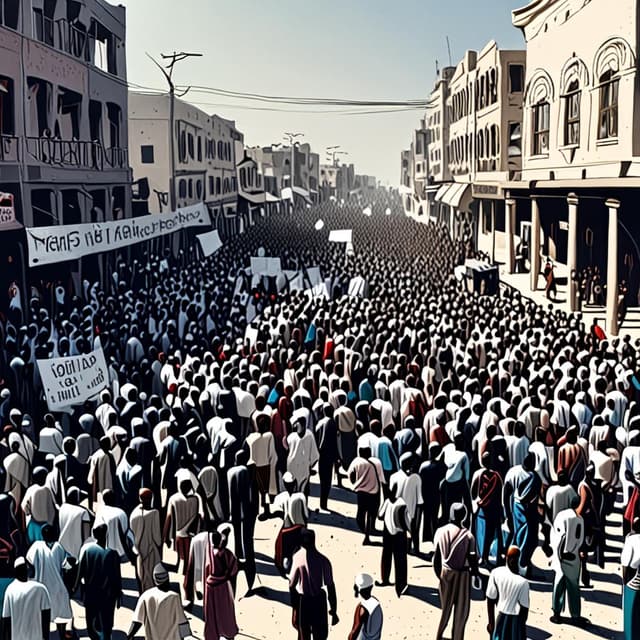
In May 1975, large-scale protests broke out in Mogadishu over the worsening economic conditions. Thousands took to the streets, demanding lower food prices and more government assistance. What began as peaceful demonstrations soon turned violent as security forces moved to disperse the crowds.
The government's response was swift and brutal. Soldiers opened fire on protesters, killing dozens and wounding hundreds more. Mass arrests followed, with opposition leaders and activists being detained. This heavy-handed crackdown only served to further inflame public anger.
The violent suppression of the initial Mogadishu protests sparked a wider uprising across Somalia. Protests spread to other major cities, with crowds attacking government buildings and clashing with the military. A diverse coalition of opposition groups, including socialist and nationalist factions, began organizing an armed rebellion.
Over the following months, the conflict escalated into a full-blown civil war. The Somali military struggled to contain the spreading unrest, and the monarchy's legitimacy crumbled. In October 1975, King Mudaffar Gobrono was overthrown in a coup led by leftist military officers.
The new socialist government that emerged from the chaos quickly sought closer ties with the Soviet Union, receiving military and economic aid. This ideological shift had profound long-term impacts on Somalia's domestic and foreign policies.
The tumultuous events of 1975 reshaped Somalia's trajectory for decades to come. The collapse of the monarchy and establishment of a Marxist-Leninist regime ushered in an era of authoritarian rule, suppression of dissent, and economic centralization.
While the initial protests were triggered by economic woes, the civil war and regime change had deep political consequences. Somalia was drawn into the geopolitical rivalry of the Cold War, becoming a client state of the Soviet Union until the regime's collapse in the early 1990s.
The legacy of the 1975 uprising lives on in Somalia's turbulent political history. The country's struggle with poverty, famine, and instability can be traced back to the unrest and upheaval of that fateful year. Even today, the memory of those protests and the ensuing civil war continues to shape Somali national identity and politics.
